

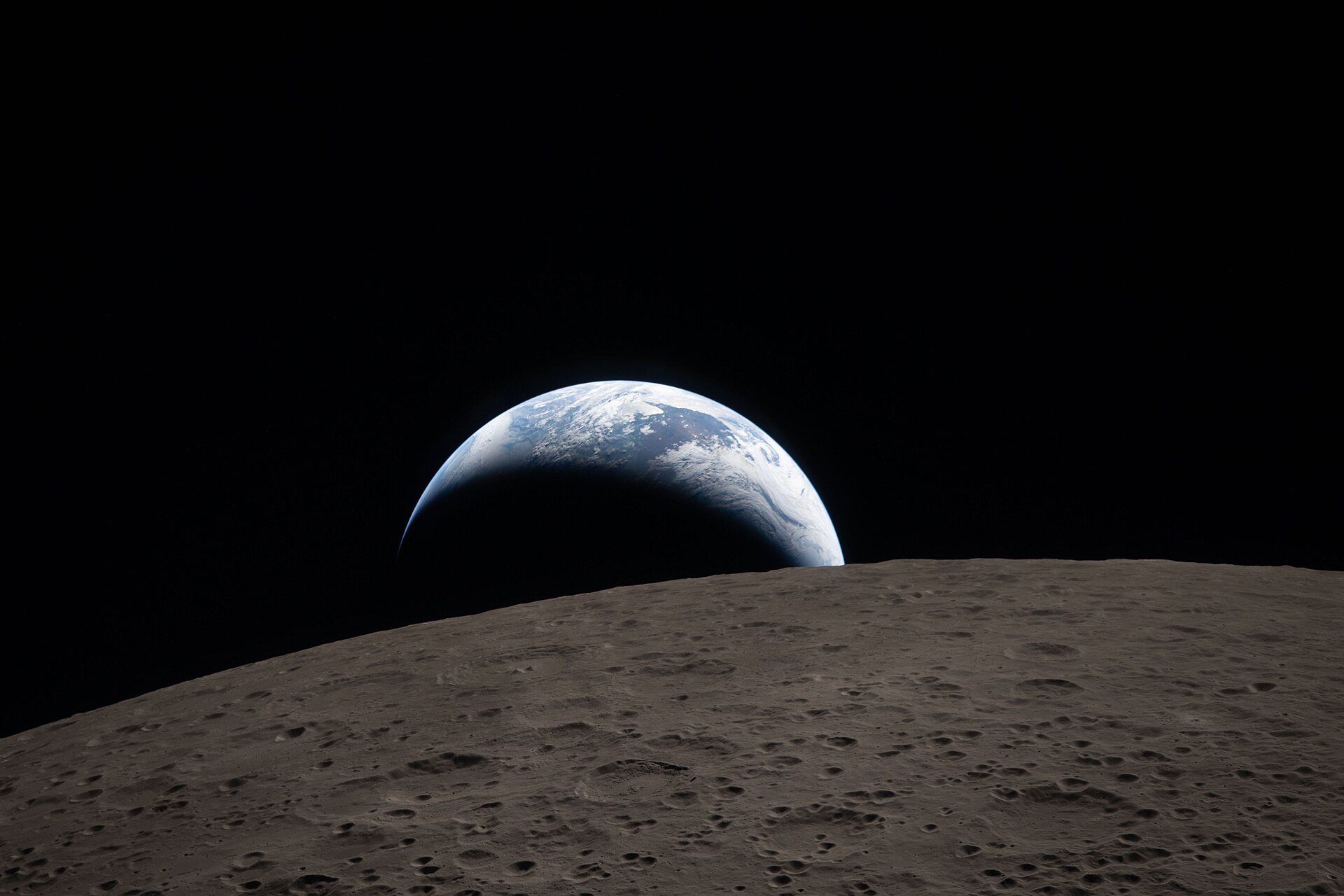
The first lunar age was a race. Flags, footprints and a hurried collection of rocks served a contest between superpowers, and when the contest ended, so, largely, did the going. The return now taking shape has a different logic altogether. This time the aim is not simply to arrive but to stay, and staying requires something the Apollo programme never needed: local resources.
That shift explains the geography of modern lunar ambition. Attention has swung to the Moon’s south pole, where permanently shadowed craters are believed to hold water ice preserved for billions of years, while nearby ridges enjoy near-constant sunlight for power. As NASA sets out in its Artemis programme materials, the Moon is increasingly treated not as a destination for brief visits but as a testbed for living off the land, a skill any serious Mars expedition will require.
Water Ice Changes Everything
Water is the most useful substance a lunar settlement could ask for, far beyond drinking. Split by electrolysis, it yields oxygen for breathing and hydrogen for rocket fuel. Left whole, it shields habitats from radiation and fills everything from cooling systems to greenhouses. Every kilogram found on the Moon is a kilogram that need not be lifted out of Earth’s deep gravity well at ruinous expense.
The catch is that the ice remains more inferred than surveyed. Orbiters have detected its signatures, and an impact experiment famously kicked up a plume rich in water, but nobody yet knows its exact distribution, depth or purity, or how hard it will be to extract from soil in permanent darkness at temperatures that make ordinary machinery brittle. Robotic prospectors must answer those questions before architects can honestly design around the answers.
Who Is Going, and Why Now
The cast has widened far beyond two rival space agencies. The United States and its Artemis partners, China and Russia with their own lunar station plans, India and Japan with successful recent landers, and a growing fleet of commercial companies all intend to operate on or around the Moon this decade. Falling launch costs, driven by reusable rockets, have transformed missions once unthinkable into line items that private firms can bid for.
Motives vary by capital. Some governments seek prestige and technological leadership, others scientific return from a world that records the early history of the Earth-Moon system, and companies see contracts today with markets, in propellant, power and communications services, possibly to follow. This plural, overlapping scramble is messier than the old race, but also more resilient: no single cancellation can end it.
The Rules Nobody Has Written
International law offers principles rather than a rulebook. The Outer Space Treaty forbids national appropriation of the Moon, but it was written for an era of brief visits, not mining camps, exclusion zones around ice deposits and competing claims to the same sunlit ridge. Newer accords propose safety zones and resource rights, though not all lunar powers have signed them, and their legal weight remains contested.
The practical questions arrive sooner than the legal answers. Who may extract ice from a crater another nation surveyed? What happens when one operator’s dust, travelling for miles in vacuum, settles on another’s solar panels? How are heritage sites such as the Apollo landing grounds to be protected? The history of Earth’s frontiers suggests that norms set early, while activity is still sparse, are far easier to agree than rules imposed after disputes harden. The Moon’s second age will be defined as much by the diplomacy of the next decade as by its rockets. The prospectors, lawyers and engineers who settle those questions will shape lunar history as surely as the astronauts who land there.
Read more on newsthe.com and in our Tech pages.
